Key Facts:

  • The Barbados Welcome Stamp is a 12-month visa for remote workers earning at least USD $50,000 annually. Individual applications cost USD $2,000; family applications cost USD $3,000.
  • Welcome Stamp holders pay no Barbados income tax on foreign-sourced income under the Remote Employment Act 2020.
  • The programme is renewable, and Cabinet has extended it through 31 December 2026. Renewal fees may be discounted, but that detail should be checked against the latest official guidance before publication
  • The indicative monthly cost of living in 2026 sits between USD $2,500 and USD $4,700 per month depending on lifestyle. The most common long-term route for those who want to stay past the renewal window is the Special Entry and Reside Permit (SERP), often backed by a property purchase.


What is the Barbados Welcome Stamp, and who qualifies in 2026?

The Welcome Stamp is a 12-month remote-work visa for non-Barbadian employees, contractors and self-employed remote workers who can show at least USD $50,000 in annual income from work performed outside Barbados. The programme launched in June 2020 under the Remote Employment Act and exempts holders from Barbados income tax on that foreign-sourced income for the duration of the stay.

To qualify in 2026 you need three things on the table: proof of income (or savings sufficient to support yourself and any dependants), valid international health insurance covering the full 12 months, and a clean enough background check that the Chief Immigration Officer doesn’t return a derogatory security report. The full eligibility brief lives on the official Ministry of Foreign Affairs page and on the application portal at barbadoswelcomestamp.bb.

In our experience helping UK and US clients move to Barbados, the income-proof step trips up more first-time applicants than any other line item. Invoices from your own LLC or limited company count, but only for work performed outside Barbados — Barbadian-source income is explicitly excluded. Contractor day rates, salaried pay, and consultancy retainers all qualify; the test is the source of the work, not the corporate wrapper.


Who counts as a “remote worker”

The Welcome Stamp is written broadly. It covers:

  • Employees of non-Barbadian companies working remotely.
  • Self-employed contractors and freelancers with overseas clients.
  • Business owners whose operations are genuinely location-independent.

What it does not cover is local employment. If you intend to be paid by a Barbadian employer or to take on Barbadian clients, you need a work permit instead — and that is a different programme with different costs.

How much does the Welcome Stamp cost, and how long does it last?

The Welcome Stamp costs USD $2,000 for an individual application and USD $3,000 for a family application, paid once at application. There is no annual fee on top of that for the initial 12-month period. The figures are confirmed on the official Visit Barbados Welcome Stamp page and the PwC Barbados 12-month brief. 

The visa runs for 12 months from issue. Renewals are available with a 25% discount on the standard fees. Cabinet approved the renewal of the programme on 26 October 2023, extending it until 31 December 2026 — meaning the route is stable for at least the next 18 months from the date of this guide.


What “tax-friendly” actually means

The Remote Employment Act 2020 exempts Welcome Stamp holders from Barbados income tax on foreign-sourced earnings during the stay. That is not the same as global tax exemption. UK applicants typically remain UK tax resident in the year of the move unless they break residence under the Statutory Residence Test; US applicants remain liable for US federal tax regardless of where they live, because the US taxes citizens worldwide. The Welcome Stamp removes Barbados from the equation — it does not remove your home jurisdiction. 


How do you apply for the Welcome Stamp (and how long does approval take)?

The application is online via barbadoswelcomestamp.bb/applynow. Standard processing is roughly five to seven working days to a decision from the Chief Immigration Officer’s office. The visa is then electronically linked to your passport, so you don’t carry a physical document — Barbados Immigration sees the link on arrival.

What you’ll need ready 

  • A current passport with at least six months’ validity past your planned arrival.
  • Proof of income — recent pay slips, contractor invoices, business accounts, or bank statements showing the USD $50,000 threshold.
  • Valid international health insurance covering the full 12 months.
  • A clear photograph (passport-style).
  • The application fee, paid in USD.

We’ve watched the process tighten slightly through 2025 and into 2026 around health-insurance proof. The Immigration team checks the policy covers the full stay; short-stay travel policies are routinely rejected. If you are using your home country’s travel-insurance product, confirm in writing that it extends to a continuous 12-month residence.


What is life actually like as a digital nomad in Barbados?

The infrastructure is better than many remote workers expect, and the cost of living is higher.

Internet

Barbados has high-speed fibre across most of the island. Flow Barbados — the dominant fixed-broadband operator — averaged around 72 Mbps download on its broadband network in Q1 2025 per Speedtest data published locally, with higher speeds available on direct fibre packages in St James and Christ Church. Cafés, restaurants and most accommodation along the west and south coasts offer free wi-fi. The remote workers we talk to who run a lot of video calls universally cite the Bridgetown–Worthing corridor as the most reliable place to be based. 

Cost of living 

Honest 2026 figures from current digital-nomad sources:

  • A frugal one-bedroom lifestyle in Speightstown comes in around USD $2,500 per month all-in, per first-hand accounts on Nomads.com.
  • A comfortable furnished apartment in Holetown or Worthing plus an active social life sits closer to USD $4,000–$4,700 per month, per Nomadic Fire’s cost-of-living breakdown.
  • A furnished one-bedroom in Speightstown can rent for USD $800–$1,000 per month; the equivalent in Holetown or Worthing runs USD $1,200–$1,500.
  • Groceries for one person sit around USD $100–$150 per week; a moderate restaurant dinner with one drink is USD $25–$35.

The currency is the Barbadian dollar (BBD), pegged at 2:1 to the US dollar. Cards work everywhere; cash is useful for produce markets and ZR minibus rides.

Co-working and community

The remote-work community is small but tight. The most frequently named co-working spaces:

  • WeHub Barbados — Sugar Cane Mall, Bridgetown; hot desks and private offices on flexible terms.
  • Regus at One Welches — Welches, hot desks plus private meeting rooms; one of the first serviced-office providers on the island.
  • Nhome and similar co-living concepts — bundle accommodation with co-working for digital nomads; ask the Residence Barbados team for current operators before signing.
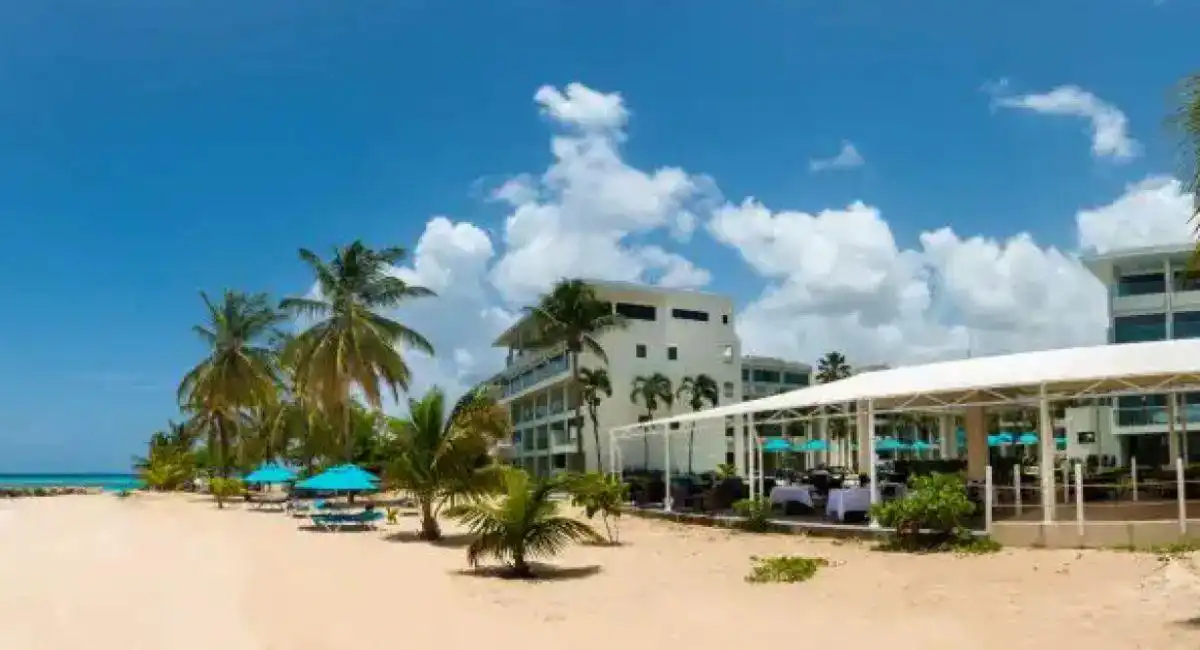

The Welcome Stampers we talk to in the agency editorial team uniformly mention the WhatsApp groups you get invited to once you arrive. The community is large enough that you’ll find roommates, sublets and shared dinners within your first fortnight, and small enough that you’ll recognise the same faces at Friday Oistins. 

Banking and connectivity

You can manage perfectly well on UK or US cards for a 12-month stay — Wise multi-currency accounts are popular among nomads, as are Revolut and SoFi. Opening a Barbadian bank account is possible but bureaucratic; most Welcome Stamp holders skip it unless they’re planning to extend into the SERP route. A local mobile SIM (Digicel or Flow) costs around BBD $30–$50 per month for a reasonable data plan. 

What happens after 12 months — renew, leave, or transition to long-term residence?

This is the question current Welcome Stamp coverage almost universally skips, and it is the question every applicant we work with asks two months into the stay. There are three options. 

Path 1: Renew the Welcome Stamp

Submit a renewal application before the 12 months are up. The fee is the standard USD $2,000 or USD $3,000 less the 25% discount. There is no formal cap on renewals — each one is approved on its own merits. The programme itself is approved through 31 December 2026; Cabinet would need to renew it beyond that date.

Path 2: Leave at the end of the 12 months 

The Welcome Stamp is not a residency commitment. Many holders use it as a 12-month trial of island life, then return to their home country, their pre-pandemic office, or another remote-friendly destination. Nothing about the Stamp obligates you to stay.

Path 3: Transition to the Special Entry and Reside Permit (SERP) 

For Welcome Stamp holders who decide they want to stay long-term, the most common pathway is the Special Entry and Reside Permit. The SERP is the Barbadian government’s long-term residence route, and the property-ownership category (Category 2) requires ownership of Barbados property valued at USD $300,000 or more.  The Category 2 SERP is issued for a renewable five-year period at a fee of USD $5,000 per adult, plus an initial application fee of USD $150

Among the Welcome Stamp holders we’ve helped convert to long-term residents, the deciding factors are almost always the same: family schooling, healthcare access, and tax positioning. The property step has to be done correctly — Central Bank of Barbados permission is required for the purchase itself before the SERP application can proceed. If this pathway interests you, read our overview of the legal process for buying property in Barbados before you commit to a property.


Frequently Asked Questions 

How much does the Barbados Welcome Stamp cost? 

An individual application costs USD $2,000 paid once at application; a family application covering spouse and dependants costs USD $3,000. These fees cover the full 12-month stay.

Renewals receive a 25% discount on the standard fee. There is no separate annual fee during the 12-month period beyond the initial application cost.

What income do you need to qualify for the Welcome Stamp? 

The Barbados government requires applicants to demonstrate at least USD $50,000 in annual income from work performed outside Barbados, or sufficient means to support themselves and any dependants for the duration of the stay. Income can come from salaried employment, contractor invoices, freelance work, or business ownership — the test is the source of the work, not the structure.

Is the Barbados Welcome Stamp renewable past 12 months? 

Yes — renewals are available with a 25% discount on the standard fees. Cabinet has approved the programme through 31 December 2026, which means new applications and renewals are open through that date. There is no formal cap on the number of renewals you can apply for; each renewal is approved on its own merits by the Chief Immigration Officer.

Do I pay tax in Barbados on the Welcome Stamp? 

Welcome Stamp holders are exempt from Barbados income tax on foreign-sourced earnings for the duration of the stay, under the Remote Employment Act 2020. You may still owe tax in your home jurisdiction — UK applicants typically remain UK tax resident in the move year, and US applicants remain liable for US federal tax regardless of where they live. Always confirm your global position with a qualified tax adviser.

How fast is the internet in Barbados for remote work? 

Barbados has high-speed fibre across most of the island. Free wi-fi is widespread in cafés, restaurants and most accommodation. The Bridgetown to Worthing corridor is the most reliable area for heavy video-call work. 

Can a Welcome Stamp lead to permanent residence? 

Not directly — the Welcome Stamp is a 12-month renewable visa, not a residence permit. A common long-term pathway is the Special Entry and Reside Permit (SERP), which can be backed by a property purchase of USD $300,000 or more. Category 2 SERP holders aged 60 or above at application receive an indefinite-term permit; younger applicants receive renewable five-year terms. Subsequent permanent residence is a separate Immigration Department determination. 

About this guide 

This guide was prepared by the Residence Barbados editorial team in June 2026. Primary sources include the Barbados Ministry of Foreign Affairs Welcome Stamp programme page, the official application portal, the Visit Barbados Welcome Stamp overview, the Invest Barbados page on the programme and the PwC Barbados 12-month brief. Secondary sources include the digital-nomad community at Nomads.com and conversations with Welcome Stamp holders Residence Barbados has worked with through 2025 and 2026. All factual claims were verified against the named primary sources before publication.


Disclaimer:
This content is provided for general informational purposes only and does not constitute legal, financial, or tax advice. Visa fees, eligibility rules, processing times, property laws, tax rates and exemptions in Barbados may change. Always consult a qualified Barbadian attorney and independent financial advisor before making any property purchase, visa application or investment decision.