You’ve gotten everything sorted out for your dream home in Barbados. But your nine-year-old daughter just asked the question that stops every expat parent cold: “Where will I go to school?”
This single question has the potential to derail more relocations than visa complications or property searches. You can find the perfect home, secure your permits, and plan your move down to the last detail—but if your children end up unhappy or stuck in an exhausting commute, the dream can unravel fast.
This guide focuses on how schooling actually works in Barbados, what curricula are available, and what to expect for timelines and costs, using government and school-published information available to the public.
Here’s everything you need to know.
Quick Read
Barbados has a British-influenced, three-term school structure with strong public (government) schools and a range of private options, including internationally oriented pathways like Cambridge and the International Baccalaureate (IB).
Public (government) schooling does not charge tuition, while private school fees vary widely by school and age group.
If you’re comparing international-style options, note that The Codrington School publishes its 2025–2026 fees in US dollars (USD), while Lockerbie College publishes its investment/fees in Barbados dollars (BBD) per term.
Not time to read? See our video:
How Does the Barbados Education System Work?
Barbados’ education system includes early childhood, primary, and secondary education, with secondary placement tied to the Barbados Secondary Schools’ Entrance Examination (BSSEE), often referred to as the “11-plus.”
Primary education typically spans roughly ages 3+ to 11+, and secondary education generally serves students from about 10+/11+ through 16+, with some schools also offering sixth form.
At the secondary level, students commonly sit Caribbean Examinations Council (CXC) qualifications—most notably CSEC (Caribbean Secondary Education Certificate) and later CAPE (Caribbean Advanced Proficiency Examination), depending on the school and pathway.
However, the government plans to replace the 11-Plus examination with a hybrid assessment system by 2028.
School year timing
Barbados schools commonly operate on three terms, but exact dates change by year—so it’s best to confirm the current official calendar before planning a move.
For example, the Ministry of Education’s official 2025–2026 calendar lists Term 1 as 8 Sept–11 Dec 2025 (students), Term 2 as 6 Jan–1 Apr 2026 (students), and Term 3 as 21 Apr–2 July 2026 (students).
If possible, plan arrivals around the start of Term 1 (September) to reduce disruption and improve placement options
Public vs Private Schools in Barbados
Government schools follow the national curriculum and typically prepare students for CXC examinations, such as CSEC (and, for some students/schools, CAPE later).
Private schools may still teach the Barbadian curriculum, but some also offer internationally oriented routes (for example, Cambridge pathways or IB programmes), often with smaller classes and additional learning-support services.
A useful first decision is whether your child needs a Barbados curriculum route (CSEC/CAPE) or an internationally portable curriculum (Cambridge/IB) for an eventual return abroad.
Curriculum Choices that will Shape Your Decision
You will encounter three primary curricula in Barbados, and your choice of school will determine the curriculum your child follows:
- Barbadian Curriculum: It aligns with Caribbean education standards and prepares students for CXC examinations recognised regionally and internationally.
- International Baccalaureate (IB): This curriculum offers globally recognised qualifications through primary, middle, and diploma programs.
- Cambridge International Curriculum: It provides British-aligned education leading to IGCSE and A-Level qualifications.
What are the Top Schools for International Families in Barbados?
Below are frequently shortlisted schools; always confirm current admissions criteria and fees directly with the school.
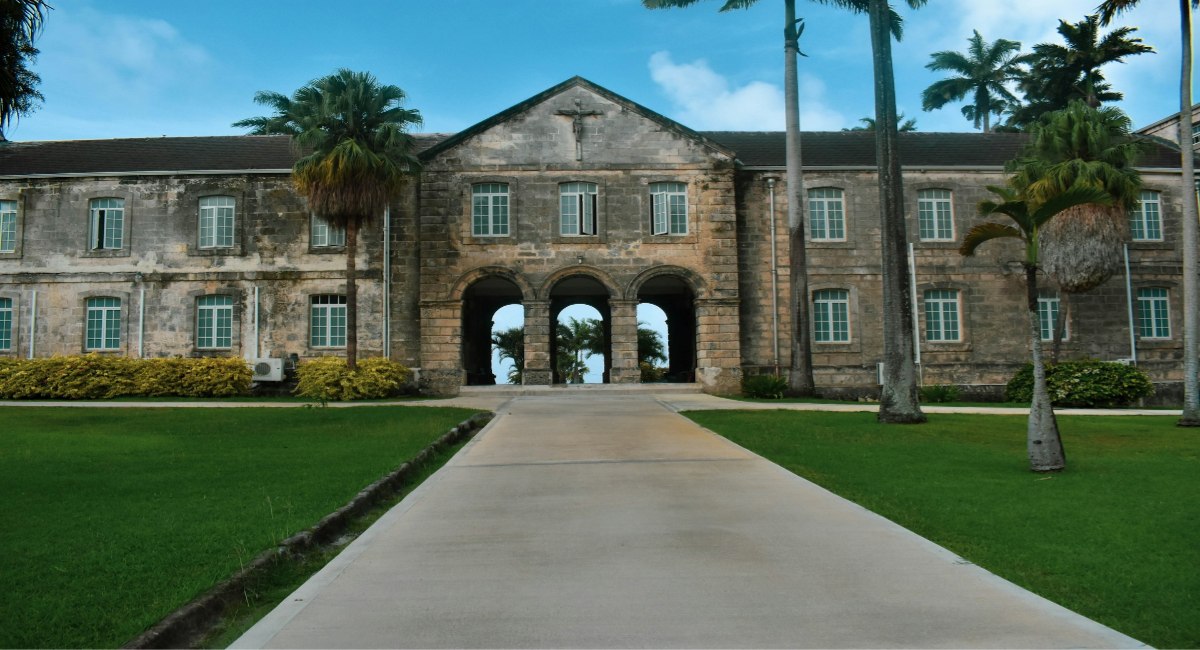
The Codrington School (St. John)
The Codrington School is an IB World School and is listed by the IB as offering PYP, MYP, and DP. Its official 2025–2026 fee statement specifies that fees are quoted in US dollars (USD) and lists annual “Regular Fees” (non-Barbadian/Caricom) up to US $22,660 for MYP 1–DP2.
The same document also lists additional charges such as an application fee and an admission/capital assessment fee (with amounts varying by year level), so families should budget beyond tuition alone.
Key Details
Ages: 3–18 years (school divisions vary by programme).
Curriculum: IB (PYP, MYP, DP).
Location: St. John.
Tuition: Published in USD; Contact the school for current fees
Lockerbie College (St. Michael)
Lockerbie College positions itself as a Cambridge pathway school and publishes 2025–2026 fee information as “your investment” in BBD per term.
Key Details
Ages: School accepts multiple levels through secondary/sixth form (confirm exact entry by year).
Curriculum: Cambridge pathway (with IGCSE and AS/A Level options described).
Location: St. Michael.
Tuition: Quoted in BBD per term; varies by level/subject load (Contact the school for current fees)
Providence School (St. George)
Providence School publishes tuition fee pages stating new applications must include a $250 processing fee and a one-time $2,500 capital levy due upon acceptance (fees in Barbados dollars).
Tuition varies by grade and is published by the school by division and academic year.
Providence operates as a Christian school and presents its environment and programming accordingly in its school materials.
Key Details
Ages: By division (confirm by campus/level).
Curriculum: Published by the school (confirm the current mix by division).
Location: St. George.
Fees: Contact the school for current fees
St. Winifred’s School (St. Michael)
St. Winifred’s School states it was founded in 1921 and serves students from pre-kindergarten (age 3) through secondary (age 16).
The school positions itself as private and co-educational, and it provides details on its structure via its own FAQ/history pages.
Key Details
Ages: 3–16 years.
Founded: 1921.
Location: St. Michael.
Tuition: Contact the school directly for current fees.
St. Gabriel’s School (St. Michael)
St. Gabriel’s is widely described as a private school serving early years/primary levels, and families should confirm the exact age range, curriculum, and current fees directly with the school.
Top Government Grammar Schools
Harrison College was founded in 1733 and operates as Barbados’s premier co-educational secondary school. It traditionally admits the top 120 students in the national 11-plus examination and maintains a minimum pass rate of 75% at CSEC and 70% at A-Level. Harrison College is described as “The Eton College of Barbados” and has produced notable leaders.
Queen’s College was officially established in 1883 and serves approximately 1,000 students. It maintains strong academic standards, with approximately 95% of graduates entering universities in the West Indies, Britain, Canada, and the United States annually. Queen’s College was originally founded as a first-grade girls’ school but became co-educational in 1981.
Combermere School, dating back to 1695, became the first secondary school to offer education to underprivileged people on the island and won its first Barbados Scholarship in 1967. It also broke the traditional distinction between first-and second-grade schools. Combermere School’s notable alumni include Sir Frank Worrell, Sir Wesley Hall, and international pop star Rihanna.
How Much Does Education Cost in Barbados?
Government schools: Barbados’ Ministry materials describe government schooling as tuition-free, and Barbados also operates support mechanisms like a textbook loan scheme in secondary schools.
Private schools: costs vary widely and are best stated as “school-dependent,” with families confirming published fee schedules directly (as demonstrated by Codrington’s 2025–2026 USD schedule and Lockerbie’s 2025–2026 BBD-per-term structure).
Additional Costs You Need to Budget
Many private schools list non-tuition charges (application fees, supply/resource fees, exam fees, and other billed items), so budgeting should include these line items—not just tuition.
Commute and transport costs depend on where you live and where the school is located; for neighbourhood planning, it helps to compare school locations against your short list of areas before committing to a lease or purchase.
If you’re trying to get an estimate of costs related to housing, looking at our homes for sale in Barbados will give you a good idea of current prices.
If you have already decided where to buy a house and are considering the next steps, you may want to look at the legal process of buying property in Barbados
How Do You Choose the Right School for Your Family?
Start with these practical considerations before looking at school rankings or facility tours.
Questions You Should Ask Before Enrolling
Curriculum continuity: If your child may transition back to the UK/Canada/US system later, prioritise a curriculum with clear international recognition (IB or Cambridge routes), and confirm the exact programme authorization and exam route with the school.
Learning support/ESL: Some schools explicitly describe inclusion and ESL support, but the availability and the cost can vary and may include additional charges.
Commute reality: Barbados is small, but daily traffic and cross-island routes can still add stress—so shortlist schools first, then choose neighbourhoods (or vice versa) with realistic drive times.
Special educational needs: Does your child require learning support? Schools like The Codrington School maintain learning support departments but admit only students whose educational needs they can appropriately meet. Make sure you research available support services before assuming accommodation.
The Application and Admissions Process
Private school admissions vary, but schools commonly request academic records and an application process that may include fees and deadlines published by the school.
For government school placement for non-nationals, families should expect Ministry involvement and documentation requirements (residency/records), though exact steps should be confirmed with the Ministry for the year of entry.
Immigration status matters: some families (for example, those on the Welcome Stamp) may have different requirements for children, so it’s best to confirm student immigration permissions directly through official Barbados government guidance.
Additionally, student visas are required for all non-Barbadian students studying in Barbados, with application forms available from the Barbados Immigration Department or its website. Ensure you begin visa applications early, as processing times vary, and you cannot enrol your children without proper documentation.
School Year Timing and Transitions
Barbados schools operate three terms, starting the second week of September through mid-December, the first week of January through the end of March, and mid-April through the end of June. So plan your relocations to align with natural term breaks. You should arrive before September to allow time to settle in before school starts.
Mid-year transfers can disrupt learning because children joining in January or April have to catch up on missed curriculum. If mid-year moves are unavoidable, then work closely with the school to arrange orientation and catch-up support.
What Do Expat Parents Need to Know About Settling Children?
Moving countries represents a major upheaval for your kids. You’re managing your own relocation stress while helping kids process leaving friends, changing schools, and adapting to new accents, foods, and routines. Here are some smart preparation tips to make this transition smoother.
Making Friends and Building Connections
Your children can make friends quickly if you facilitate connections by arranging playdates, inviting classmates to weekend beach trips or home visits, and encouraging your kids to participate in extracurricular activities.
International schools naturally support transitional children because most students share expatriate experiences, while government schools require more intentional integration efforts. Your children might initially stand out as “the new foreign kids.” But all that could change in a few weeks.
Understanding Cultural Adjustments
Barbadian schools have stricter discipline standards than many international systems. Some rules include wearing uniforms correctly, punctuality, and appropriate respect for teachers. This formality sometimes surprises families from more casual educational cultures. You can frame these expectations as interesting cultural differences rather than restrictions, so your kids can settle in quickly.
Children will also encounter the Bajan dialect. Most children find this fascinating rather than confusing. Within months, your kids might surprise you by “talking Bajan” at home.
Connecting with Expatriate Families
International schools serving expatriate communities often facilitate parent networks and social connections. It helps families transition by introducing them to others sharing similar relocation experiences. You can do this by attending school social events, joining parent associations, and participating in family activities.
Online expat communities can also provide valuable support and practical advice. Platforms like Facebook groups, WhatsApp communities, and forums connect newcomers with established expatriate families. These connections can help you get answers to questions about everything from uniform supplies to recommended paediatricians.
Finding the Right Educational Home
Your children’s education shapes their Caribbean experience as profoundly as your property choice or neighbourhood selection. Good schools provide more than academics. They offer community, friendship networks, and cultural integration.
Take your time to research schools thoroughly and visit campuses when possible. Ask difficult questions about curriculum, support services, and cultural fit. Then trust your instincts about which environments will help your children thrive.
At Residence Barbados, we understand education represents just one piece of your relocation puzzle. You’re simultaneously researching property options, visa requirements, and international moving logistics. We’re here to help connect all those pieces together and answer questions about your school locations relative to residential areas.
Contact our team at Residence Barbados today. We’ll help you find the perfect home that supports both your lifestyle dreams and your children’s educational needs.
FAQ: Quick Answers to Common Barbados School Questions
Can my children attend Barbados public schools as non-citizens?
Yes, non-Barbadian children may attend government schools upon approval from the Ministry of Education. You will need proof of legal residence in Barbados, academic transcripts, and student visas for your application.
What’s the difference between Harrison College and international schools like Codrington?
Harrison College operates as a prestigious government grammar school following the Barbadian curriculum and preparing students for Caribbean examinations. The Codrington School is a private international school offering complete IB programs and welcoming students from all backgrounds who can afford tuition.
Do Barbados schools teach in English, or will my children need language support?
All Barbados schools conduct instruction in English and follow the British educational model. The schools provide support for students still developing English proficiency, though international schools typically offer more structured ESL programs than government institutions.
When should I start the school application process?
It is best to begin research and applications 6-12 months before your intended relocation date. Popular private schools maintain waiting lists and may require entrance examinations. And government school placements through the Ministry of Education require time to process.
This material provides general context on the Barbados residential buying process. It is not financial, tax, legal, or investment advice, and does not constitute a recommendation to transact.